Thursday, September 1, 2022

The Athasian Solar System


I’ve been meaning to write this article for some time, but needed to detail out a few things prior to publishing it. On occasion the question comes up asking what we know about the Athasian solar system.  Some have speculated that there are no other planets in the system, or that there were other planets but they were consumed by the sun when it underwent its transformation. Others speculate it is a full system with a fair number of planets and moons. 

Over the years I’ve collect the various pieces of info in the various sources.  What I found was there is very little information. However, some inferences must be made to detail anything out and 2e has the best sources for doing that.  Let's start with what we do know about.  We know the following:

Sun - the sun - sure it's a problematic sun and changes colors as the inhabitants of Athas muck with it, but it's the only one they got.

Athas - home.  The planet that everything happens on. Well, almost. It's somewhat earth-like, has life, has gone thru phases. Right now its very desert-like. It has two moons.

Guthay - the bigger moon (don't go 4e on me… It is bigger.) (Source.)

Ral - the smaller moon (again, don't go all 4e on me... It is smaller) (Source.)

The Messenger - a comet that appears every 45 years.. It's bright when it appears too.

That's all that really gets any attention other than other planes and whatnot. What else is in the night sky?  Well you have the constellations. All 12 of them. And the three cusps.

Balimarash the Caravan
Fiddle the Beetle
Hesper the Kenku
Saurus the Lizard
Cusp 1
Hortle the Spider
Sylk the Wyrm
Tasker the Scorpion
Pyrus the Wheel
Cusp 2
The Dragon
Tyrospur the Lion
Scratch the Basilisk
Krawler the Kank
Cusp 3

 But those aren't really the planets and not part of the "solar system" Are they? Just the stars in the background, but they are important and play a role. I explain more below.

There are two other signs in the cosmos that aren't readily apparent to most. Those are the Endlean cycle and the Seofean cylce. The 2nd Edition Revised DS Box Set has the following:

 "In the Calendar of Kings, years are counted off using a pair of concurrently running cycles: one of eleven parts, the other of seven. The eleven-part, or endlean cycle, is counted and spoken first, in the order presented above. The seven-part, or seofean cycle, is counted and spoken second. The endlean cycle is complete when Athas’s two moons, Ral and Guthay, meet in the heavens, resulting in a major eclipse that occurs every 11 years. The seofean cycle is more abstract, occurring after Agitation has led back to Fury in the cosmos."

When it comes to other planets, this was one place I looked. The first idea that comes to mind here was to just make two different planets: one with a 7 year period, let's call it "Seofea", and the other with an 11 year period, let's call it "Endlea".  This was touched upon years ago by Agantyr in his readme file of his merchant calendar program. (Source)  His comment there for the Seofean cycle was the following:

 "The first is the "Other Planet" theory.  This would be a large, possible gas giant with an orbital period around the dark sun of 7 years.  (Jupiter has an orbital period of around 12 years, so this is not unreasonable.)  This planet would pass through the same constellations in a 7-year cycle (as viewed from Athas).  The only problem with this theory is that there are already 12 constellations that are associated with the months.  For the planet theory to really be solid, the names in the Seofean cycle would have to correspond to 7 constellations."

 This relates to the idea that our own zodiac was created by watching Jupiter with is 11.86 year orbital period.  Think about where the stars are that are behind Jupiter or next to it at the start of each year.  Jupiter travels along the ecliptic and takes a full year to go through about one of our twelve constellations. Thus, we get twelve of them as it makes a complete cycle to get back to the stars it started on. Fine.

 But what if you do have a planet that takes 7 years to get around the sun? Do you then get seven constellations? Well, not necessarily. If Athasians are using that planet to help keep time and they want to name the seven cycles, the inhabitants can simply just give names to the stars that the planet is near at the start of each year.  So you give the brighter stars names where ever Seofea is on days of significance. i.e. the first day of the year.  Any name will do.  It just so happens that perhaps they chose: Fury, Contemplation, Vengeance, Slumber, Defiance, Reverence, and Agitation for some of the names of these brighter stars along the ecliptic.  Which is what I decided to do on my star map. These would be spaced out approximately 51.4 degrees apart.  Having a constellation that covers 51.5 degrees is a lot more difficult to deal with than one that is only 30 degrees.  Really Athasian constellations cover about 28.8 degrees each, if you account for the three "cusps". So perhaps Athasians just decided to divide the heavens into something more manageable, or perhaps the natural "break" in the stars and constellations “the cusps” helped to do this for them.


The other theory I have for the 12 constellations is that they are based on the moon cycle. I refers back to their orbital periods. (Source). The cusps would correspond to days when Guthay approaches being full in the sky. The twelve divisions could be due to Ral’s sidereal period of 30.33. In 375 days, Ral will pass through the entire zodiac 12.36 times. So 12 could be a natural division for the zodiac. When Ral completes each cycle a new constellation starts to rise and an old one sets.

Trying to name the phases of the Endlean cycle after stars is a little more difficult.  The 12 "Earth" constellations of the zodiac mentioned above were possibly created by a planet (Jupiter) with a twelve year cycle.  This idea versus the idea of having a planet with an eleven year cycle doesn’t translate as easily.  Of course you still could have a planet with an 11 year cycle, and I like this idea, but with cycle names already like "Ral" and "Guthay" it doesn't fit with the idea of naming these cycles for stars. The names of the Endlean cycle are a mix of elements, moons, people, centered about the "Dragon".  But the names may have referred to other events in the cosmos or event on Athas. My suggestion here is to still have a planet named "Endlea" but just have the reason for the naming of its eleven cycles lost to time; similar to the way the Heavenly Stems from of the Chinese calendar's sexagenary cycles have some ambiguity in their origins. However, it has been proposed there that the Chinese names of the Heavenly Stems refer to asterisms along the ecliptic that the moon passes. (Source).  This could be the case on Athas as well. 

Moving on from the Endlean and Seofean cycles, there is scant other references in the books.  There are references in 2e to psionic powers with ranges described as "interplanetary" (DS 2e Revised, Dragon Kings, Will and the Way) If Athas is a lone planet in the solar system, why bother having spells that have an interplanetary range?  Or why bother having this detail if interplanetary ranges are never meant to be attempted.

The best source outside of any of the core rulebooks for planets comes from the adventure "Marauders of Nibenay." There, the PCs enter the Fortress of Nibenay and enter one of the rooms that contains a giant orrery.  The description for the DM to read to the players says the following:

"This room, fully 100 feet wide and 150 feet long, is completely given over to one of the most amazing machines you have ever seen. The heart of the device is a large, spherical clockwork mechanism that contains thousands of delicate looking gears, wheels, and spings, all moving with what appears to be absolute precision. A dozen slender rods jut out from the massive central sphere, each ending in an assembly of globes that appear to move in circles, about each other and then (as a group) about the mechanism itself. Exits can be found on the north and west walls, but the convolutions of the machine make moving from one door to the other a very difficult task."

It then goes on to provide the following detail to the DM:

"This device is an orrery, a mechanical representation of the Athasian solar system. Nibenay, like many of his subjects, has a keen interest in astrology and has built this machine to help him his studies of the stars and the portents they bring. Any character who makes an Astrology check should be able to deduce the function of the machine and understand its value as an aid to astrological studies"

Voila! A description of the "Athasian solar system."   A careful reading of the text will also indicate that up to possibly twelve planets/bodies exist.  "A dozen slender rods" - (each potentially representing a planetary system) "jut out from the massive central sphere" - (which would be the position of the sun) -  "each ending in an assembly of globes" - (a planetary system)


The accompanying picture has a bit to be desired as far as orreries are concerned.  It is not presented in the conventional format of orreries as it lacks an obvious central globe for the sun that is seen in typical orreries, but it is the best we have and we can still infer some things. (Although it did occur to me that the orrery could be a geocentric model and not heliocentric model, thus moving the sun from the center.)

Although this is only one side of the orrery in the image, I decided to take it and group planetary bodies by what I could tell was an assembly of globes, and produced the following image:


I labeled these clockwise to assist referring to them. While I get 8 separate groupings here there are a total of 20 visible planetary bodies.  I list them as follows with some speculation:


  1. 1 gas giant planet 6 moons  -This appears to be a large moon, possibly a gas giant with several moons.
  2. 1 gas giant planet - This appears to be another large planet a gas giant with rings - no moons (or none discovered)
  3. 1 planet 2 moons  - this fits the bill for Athas.
  4. 1 planet - just a lone planet out there
  5. 1 gas giant planet 4 moons - I'm going to go with a large gas giant, but with two bodies off the page makes it difficult to know.
  6. 1 planet - another lone planet chilling out here.
  7. 1 gas giant planet -  yet another lone planet.
  8. 1 planet - another small one… maybe we just say this is the Messenger since we still need to account for it.

That means there would still be four other unaccounted for planetary systems (based on the 12 rods = 12 planets assumption) and it consists of at least four gas giants and 4 rocky planets. (Maybe you decide something a little different.)

Now we're cooking.  But what is the order?  There has been some parallels of Mars to Athas and inference over the years that Athas is in the same position as Mars or the fourth planet.  (Source.) People like to compare Athas to Mars. (John Carter) But it doesn't jive with the orbit of Athas (375 days) vs orbit of Mars (687 days). Also, I am opposed to a Mars-sized Athas (Source.), but I am ok with it being a fourth planet.  Here is my logic.

A while ago I stumbled upon an article that proposed there being an extra planet between Mercury and Venus at one time.  The premise involves some complicated equations that evaluate the harmonic resonances of known positions of planets to determine stable orbits of other potential planets.  It is used to predict additional exoplanets in other star systems.  And the method is pretty reliable. When the Harmonic Orbital Resonance Model is applied to our solar system the best fit adds the extra planet between Mercury and Venus and excludes Neptune. (Source.)  

If we allow the "Extra" planet, supposing it hasn't been "thrown out of the system yet" (see three body problem) and we keep Neptune by saying it "occupies a stable orbit between Uranus and Pluto, which does not match the primary progressive geometric pattern, but fits a secondary harmonic pattern." we end up with a decent list of planets.  And we then add an equivalent to Halley's Comet, the Messenger.

 I figure we put the order similar to our own system. For our own system we might get something like this (including dwarf-planets) - and that's twelve.  - of course you could add all the other objects beyond Pluto, but at least now I have 12 objects. (I've separated Halley's Comet since it is an oddball)


Planet

Days

Years

Mercury

88

0.240931

Extra

176

0.481862

Venus

225

0.616016

Earth

365.25

1

Mars

687

1.880903

Ceres

1682

4.605065

Jupiter

4331

11.85763

Saturn

10747

29.42368

Uranus

30687

84.01643

Neptune

60190

164.7912

Pluto

90560

247.9398


Haley

27394

75


Now we just plug in the equivalent or make some approximations.  I am taking some liberties with the exact days here to simplify things since this is a game. And these are not all orbits that conform with the Harmonic Orbital Resonance Model.- but at some point in your game you have to break physics and this is where I am breaking it.


Planet

Type

Days

Athas Years

1

I

rocky

93.75

0.25

2

II

rocky

187.5

0.5

3

III

rocky

251.25

0.67

4

Athas

rocky

375

1

5

V

rocky

750

2

6

VI

rocky

1500

4

7

Seofea

gas giant

2625

7

8

Endlea

gas giant

4125

11

9

IX

gas giant

11250

30

10

X

gas giant

33750

90

11

XI

rocky

67500

180


12

Messenger

comet

16875

45


Now we just need some names for them… many languages over the millennia have used the names of deities for planets. Time keeping has also used names of deities and names of celestial objects for names of days of the week or names of months. But "Athas" = no gods, so I decided not to go that route.  Really the names of these planet could be a named anything, but I wanted to use Athasian names. So I looked to the names of the Athasian months to use as an analogue. I figured if the Athasians can come up with names for their months that aren't tied to deity then let's use those.  What I ended up with is the following:


Planet

Type

Days

Athas Years

Moons

1

Macro

rocky

93.75

0.25

?

2

Morrow

rocky

187.5

0.5

?

3

Thauma

rocky

251.25

0.67

?

4

Athas

rocky

375

1

2

5

Alia

rocky

750

2

?

6

Ameron

rocky

1500

4

?

7

Seofea

gas giant

2625

7

6

8

Endlea

gas giant

4125

11

4

9

Anabas

gas giant

11250

30

?

10

Hoard

gas giant

33750

90

?

11

Flagst

rocky

67500

180

?


12

Messenger

comet

16875

45

0


So there is my list.  I know, I used some liberties there, but that's the best that I can come up with for now.  Most Athasians are probably only aware of the first 8 or 9 of these planets and the Messenger.  Since the last ones are so far away would be hard to see and move across the sky very slowly.


The one last thing I wanted to address somewhat what is on each planet… largely I think this is up to the DM to decide. And I would hope they are all mostly dead planets and moons… but maybe your campaign needs Guthay to be full of silk wyrms or Flagst full of frozen undead.  But I don’t think any are teeming with normal "life".  I think this takes away from the desperateness of Dark Sun.  But how you decide to play in Dark Sun is totally up to you.  But above are just some ideas.

Enjoy.


-Rovewin


Monday, August 22, 2022

Rovewin's Dark Sun Monster Matrix


Here I have compiled almost all of different dark sun creatures mentioned across all the different Dark Sun document sources. Most of these are official and semi official.  I’ve been working on this list for several years. There are over 1200 creatures mentioned from over 150 sources.

The first column contains all the monsters listed alphabetically. The top row contains all of the relevant Dark Sun sources starting with 2e, working mostly chronologically to the right.  After all the Dark Sun sources, I list other non-Dark Sun sources, starting with 3.5 WoTC book, then Pathfinder books, other 3PP, and fan conversions where the monster has a full writeup with stats.  I indicate with a number "1"  in the column where you may be able to find stats for the Dark Sun monster listed.   

If you do ok with spreadsheets this is for you.

Link to the Excel file 

For the most part I tried to exclude individual named monsters and focused on the specific species. I do not call out NPCs typically.. though there may be some.  Also I didn’t include all the mentions of standard races like humans, elves, dwarves etc. but if it is an unique race I tried to include it. I also tried to include mentions of animals that are never stated out but exist. I tried to include a guide that shows how detailed the entry is. 4e creates some problems with naming with all of its adjective-noun names which becomes hugely complex. But I at least tried to include the base creature. 

Some have full stats with descriptions. Some have partial stats and some are just mentioned.  Some DS sources do not list any monsters because I wanted the matrix to show I accounted for the source.

Special thanks to Rajaat99 and his 2e lists and the folks in the Pristine Tower at Athas dot org. 

If there are any monsters I missed please let me know.

I still have all the new 2022 stuff released for 3.5 to account for. I also haven't touched anything yet with 5e, but it looks like I can start doing that as well.


Saturday, August 13, 2022

Dark Sun Skills for 3.5 Classes

 Ever wanted a table of all the 3.5 DS classes that showed the skills available to them?

This takes all the playable classes from DS3.5 rules and updates the skills to that rulebook.  

Enjoy! If I missed anything please let me know.


Sunday, June 19, 2022

Conjunctions part 3 - Conjunction junction, what’s your function?


Conjunctions part 3

Conjunction junction, what’s your function?

Previously, I wrote about conjunctions on Athas here and here.

So, what happens when the moons of Athas are conjunct?


Ral and Guthay meeting in the heavens

One of the biggest events to have happen in the Athasian heavens is the lunar conjunction or “eclipse” that happens every 11 years.  This conjunction happens on the first day of the year or High Sun. It also marks the start of a new Endlean Cycle.  See 2e Dark Sun Campaign Setting pg 85.

“The endlean cycle is complete when Athas’ two moons, Ral and Guthay, meet in the heaven, a major eclipse that occurs once every 11 years.” 

 The 3e DS rule book contains similar language.  See page 191.  Unfortunately, the 4e Campaign Setting only specified that “Every 11 years an eclipse occurs,” without any relation as to whether it is a lunar conjunction, a solar eclipse, or lunar eclipse. The campaign setting for 2e and 3e make it clear that it is a meeting of the two moons in the heavens.

 One of the best depictions of this conjunction his is found in the short story “Service” by Lynne Abbey in the Black Flames supplement. There, she describes an avangion casting a spell on the same day as this important conjunction as a templar, Gelmin watches on.  If the spell is not cast on that day, the avangion would have to wait for another 11 years.


 “Ral and Guthay met in the heavens as Gelmin neared the pinnacle. He watched in awe as golden light shot up from the shadows toward the moons as they conjoined. The beam brightened momentarily, then faded, but others rose to take its place, growing more intense and lasting longer as pale Ral crept across the face of darker Guthay. Gelmin shivered, but not from the chill air. The legend said that the avangion began its metamorphosis by casting golden light into the heavens to draw down the power of the moons.”

Service

 Here are some things to consider during a conjunction:

What phase are moons during the conjunction?  New, Full, crescent, gibbous, or quarter? During a conjunction, the phases of both moons will be the same.  – you won’t have a full Ral crossing the face of a crescent Guthay.

Is whatever influence during the conjunction more powerful during a full moon conjunction or a new moon conjunction? Or is it a new moon conjunction that also partly covers the sun. i.e a life spell for a full moon conjunction, and a death spell for a new moon conjunction. Balance for a quarter moon.

Are the moons waxing, waning? At the point of conjunction were the moons waxing or waning? Perhaps a waxing moon indicates a growing or increasing spell and waning indicates a shrinking or decreasing spell.             

Dragon Magazine 340 has a great article for astrology and astrological events, specifically when multiple moons are in conjunction:

·         All spells are empowered for the duration of the conjunction.

·         Any conjuration summoning spell cast during the conjunction is permanent, although the creatures summoned are free from the caster’s control after the spell’s normal duration expires.

·         Any divination, enchantment, or transmutation spell cast during the conjunction is not expended and may be cast again.

·         All those in the light of the conjunction suffer from madness, as per the spell confusion with no save, for the duration of the event.

·         All those sleeping under the light of the conjunction receive the benefits of an augury spell with a 90% chance of success.

·         Some rare event, such as a portal opening, a castle appearing, or a dark beast awakening occurs during the conjunction.


A Conjunction - Dragon Magazine 185

How long do you let the effects of the conjunction last for?

Really, the duration of the conjunction depends on the apparent size of the moons and the speed the move across the sky as one passes the other.  I’d suggest letting it trigger an effect with a specified duration.  Minor effects could last a full day and major effects last for 10 minutes.

Is the conjunction visible from your location? Only about half of the total number of conjunctions are visible at the exact moment Ral overlaps Guthay.  The other half occur on the other side of the planet.

How often does a conjunction occur? 

Conjunctions will happen every ~44.84 days if using the Merchant Calendar program. This can be calculated by using the length of the phase of each moon per this equation: (125*33)/(125-33)  125 days Guthay, 33 days Ral. Note that these conjunctions will only be visible in the sky about every other conjunction, so in reality, visible conjunctions occur about every ~89.67 days.


Conjunction ~90 days after the "Major Eclipse"


If using different durations for phases just replace the values per the equation above.  (This also assumes the moons are revolving the same direction around the planet. If different, add instead of subtracting in the denominator)

Where are the moons in the sky during the conjunction? Are they rising, at the zenith, or setting?  A rising conjunction may again indicate an increasing influence and a setting conjunction indicate a decreasing influence, while a conjunction at the zenith indicates the maximum.

What zodiac sign are the moons in? Is the effect different for a conjunction to happen in Tasker the Scorpion vs Balamarish the Caravan? Interesting to note:  The “major eclipse” that happens on the first day of the new year of the Endlean cycle (year of Ral) happens when the moons are in Tasker the Scorpion. Five and a half years later (in the year of the Endlean cycle of the Dragon) a new moon conjunction occurs as well, which would also transit the sun, it occurs in Tasker the Scorpion as well. The Conjunctions never happen in the second and third cusps. 

To assist with this, I have created a table that has all 92 of the conjunctions that are possible in the Merchant Calendar program or using 33 and 125 synodic periods.  It also includes which start sign the moon will be in per the diagram in the Ivory Triangle.  (Note: this can be different than the “Star sign” indicated in the program… “Star Sign” indicates where the Sun will be located in the constellation.  Full moons at conjunction will be in the opposite start sign.  Anyway, the table breaks it all out.


Here are some additional ideas for treating conjunctions.

Allow the effects of a conjunction to last for 10 minutes.  All magic cast during the 10 minutes of the conjunction is impacted in different ways depending on the two moons’ phases, whether they are waxing or waning, their position in the night sky, and the constellation they are in.  To use this  would first determine if the conjunction is visible or not. If you are not using the Merchant Calendar program to determine phase of the moon, you can just roll for it.


Use the following tables to determine the effect.

Phase

Percent Full*

Effect (Description)

Full

94-100

All variable, numeric effects of a spell cast under this 

conjunction phase are maximized.

Gibbous

56-94

All variable, numeric effects of a spell cast under this 

conjunction phase are increased by 50%.

Half

44-56

Variable, numeric effects of a spell cast under this 

conjunction phase are not impacted.

Crescent

6-44

All variable, numeric effects of a spell cast under this 

conjunction phase are decreased by 50%.

New

0-6

All variable, numeric effects of a spell cast under this 

conjunction phase are minimized.

*The percent full is provided in the Merchant Calendar program as either a positive or negative number. Positive if it is waxing and negative if it is waning. For the phases full, half, and new, I let there be a 6% range on either side of the exact percentage value of the phase occurrence.  This means that Ral will be full, half or new for about 3 consecutive days.  And also means Guthay would be full, half, or new for about 8 consecutive days.

Additional effects can also be determined with the following:

Position

Effect (Range)

% Roll

Zenith

Spell range is doubled

  0-4

Rising

Spell range is increased by 50%

 6-24

Setting

Spell range is decreased by 50%

25-47

Below Horizon

Spell range is decreased to 25%

48-100%


Waxing/Waning

Effect (Duration)

% Roll

Waxing

Spell duration is doubled

1 - 50

Waning

Spell duration is halved

51 – 100

This treats a full moon conjunction at 100% as waxing and a new moon conjunction at 0% as waning

 Per the Merchant Calendar, there is a conjunction every ~45 days then they occur about 2% of the time.  However, less than half of these will be visible. (48%) Visible conjunctions occur about every 90 days. On a given day, you have less than a 1% chance you have a conjunction that is visible. 

If you are not keeping track of time, or using the Merchant Calendar, or if you don’t know the particular day of the year it is, and if you don’t know when the last conjunction occurred you can use 1d100 to determine how many days until it will occur next.  The number indicated on the dice is the days to the conjunction.  A roll of 91-95 is DM’s choice and 96 or above should be rerolled.


A Conjunction

What happens during a conjunction?

According to Terrors Beyond Tyr Page 109, “Tari mate once per year. The females of a single pack go into heat during the conjunction of the moons, initiating the mating season.”

Also, in Terrors Beyond Tyr, on page 104 Stalking Horrors appear during a specific lunar alignment.  “The only reported sightings are on clear Athasian nights when the moons are in a specific alignment. The stalking horror is believed to be the result of some ancient summoning.” Perhaps these conjunctions are one of those moments.

 Dragon Magazine 185 Water and Ashes tells of a waterfall that was seen when the moons took a certain position, again, this could possibly occur during a conjunction.

The Short Story Service in Black Flames has the Avangion casting a spell on the major conjunction. (Again, see above)

The Crimson Monolith, detailed in the 2nd ed. boxed set, has certain monsters appear from out of it on certain nights when the “twin moons are high in the sky” – maybe this isn’t a complete conjunction, but the moons are approaching a conjunction.

Enslave Elemental, a spell from Dragon Kings, requires a portion of the spell to have the wizard fashion an amulet and don it and “cast the spell before the next double moon (within 1d100 days) Upon casting the elemental arrives.”

Though not a completely direct Athas reference, the book Domains of Dread contains a reference to portals that lead out of Ravenloft.  The domain of Kalidnay may be found within the Domains of Dread. 

 “While there are no permanent portals out of Ravenloft, temporary gates to the Prime Material Plane do exist. As a rule, however, these gates must be triggered by some natural or supernatural act. Examples of such triggers include astronomical phenomena (like eclipses and conjunctions), the completion of certain arcane rituals, and the fulfillment of macabre prophecies.”

 Another potential tie in, is the number 90 along with the Messenger comet. According to the Veiled Alliance book page 41, 90 is “a sacred number for Tectultitlay.”  The Draji calendar numbers years into groups of 90.  90 could also be important to them since it is the same number of days between visible lunar conjunctions. (~89.67 days).

There are a few ideas that you may find useful to further your use of the moons.


Tuesday, May 31, 2022

High Sun, Solargraphy, and Location of the Tyr Region


I wanted to do this post near the same time as the summer solstice in the northern hemisphere, June 21, the longest day of the year, but decided to do it a little early. I previously posted on solstices and equinoxes here.  On Athas, the summer solstice is also the first day of the year according to the most common calendar throughout the Tablelands. This day is Dominary the 1st and is referred to as the Highest Sun. It is the day the sun is in the sky longest and it is also the day the sun reaches its highest point of the year.  Learn more about the solstice here

Athas revolves around its sun once every 375 days. The sun is highest in the sky on Dominary first and then after that day the sun will be lower and lower in the sky each day until it reaches the winter solstice, or Lowest Sun, which occurs on Morrow the 3rd, exactly half way through the 375 day cycle. Or 187.5 days later. After that day the sun will gradually begin to climb in the sky reaching higher and higher at its zenith at noon until it hits Highest Sun again. (Please do not think that Low Sun will be hotter because “the sun is lower and thus closer to the planet’s surface, like if I get closer to a fire I get warmer” That is WRONG! It has to do with the angle of incidence - a topic for another day. 

I recently learned about a method of filming the path of the sun on a daily basis to plot the movement of the sun against the sky through the year.  This is called solargraphy. It’s typically done over several weeks or months with a pinhole camera pointed toward the direction of the sun. The result will plot the course of the sun in the sky. If started on the summer solstice and ended on the winter solstice you will get a neat plot of each day with the sun’s position clearly marked. Different latitudes will provide different arcs in the image. This short news clip video here explains it pretty well in just two minutes.  


All in all there are some amazing images that are captured using this method. I recommend you google “solargraphy” and check out some more.  There is still time to get your pinhole camera build and in place before the solstice so you can get six months worth of images.  You will want to start it by June 21st to get the full effect.

You can imagine what this would look like if done on Athas and it gives you a better idea of what Athasians would understand as High Sun and Low Sun. 

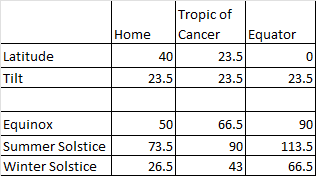
There are some pretty simple equations to calculate the position of the sun at varying latitudes for the solstices and equinoxes.  You just need two pieces of information: your latitude and your planet's tilt.


For example: I live on about 40 degree north latitude.  So, per the equation: 90-40 = 50.
Which means that when I look to the south at noon on the day of the equinox, around March 20 or September 22 the sun will be at about 50 degrees above the horizon. (Where 0 degrees is looking directly to the horizon and 90 degrees is looking directly up.) The tilt of the Earth is 23.5 degrees.

And for the next part of the equation, for the summer solstice, I just add the tilt of the Earth to that number to get 50 + 23.5 = 73.5 degrees.  And then for the winter solstice I just subtract the 23.5 from 50 and get 26.5 degrees.  Which means the sun will have a total of 47 degrees difference between the solstices (23.5 + 23.5 = 47)

You can see what happens if I live at the Tropic of Cancer. The sun will be 90 degrees above the horizon, directly above me at noon on the Summer solstice.  At the equator on the Summer solstice the Sun is now in the north sky (an answer above 90 means you have to now face the opposite direction to see the sun) It will just oscillate between the south sky and the north sky. It will stay above the 66.5 degrees above the horizon to both the south and north and on the equinox it will be directly overhead.  

Angle of the Sun on Earth

We can do a similar thing for Athas. We don't know the tilt, but for argument's sake let's assume it is roughly half of Earth's tilt, or 12 degrees.  Which contributes to its hotter climate.  This places the Tropic of Balamarash at 12 degrees North and again for argument's sake let's say the Tyr region is at the 20 parallel to the north.  This will keep the High Sun and Low Sun still discernable, but just not as extreme as what we have on Earth.  

Angle of the Sun on Athas


 If we assume Athas is approximately the same size as Earth (I believe there is plenty of good reasons to assume this: here and here). Then 1 degree latitude is equal to 69 miles (traveling north-south mind you). That would place the Tyr Region some 20*69 miles away from the equator or about 1380 miles north of the Equator. Of course you could place it in the south as well or change the tilt or latitude of Tyr.  

Here are some things to think about:

If Athas didn’t have a tilt of any kind there would not be multiple curves of varying height throughout the year  but just one curve the sun travels along each day that matches the equinox curve.  

If the tilt of the planet Athas was less than Earth’s ~23.5 degrees the distance between the highest and lowest arcs would be tighter. (For comparison Mars’ tilt is ~25 degrees and Venus’ is ~3 degrees.)

Imagine that pattern of curves permanently fixed in the sky to the south from where you live. (Assuming you live north of the equator). If you were to continuously travel south along the globe (because Athas, like Earth is roughly a sphere, not a disk) that pattern would get higher and higher in the sky, the curves would start to straighten out and go more directly from east to west to where the high sun point is directly overhead at noon on the summer solstice at the Tropic of Cancer  (The 23.5th degree north latitude) As you continue south towards the equator the entire pattern moves overhead to where the “high sun” curve is now in the north sky, and the ”low sun” curve is in the south sky. Then at the equator during the equinox, the sun is directly overhead at noon. 

If the events of Athas happened at the equator the sun would be directly overhead at noon on the equinoxes. This means that the solstices would fall equal distance to the North or South from directly overhead. There would be little ability to discern which was “summer” and which was ”winter”,  implying that instead of having a High Sun and Low Sun you would have "North Sun" and "South Sun" that corresponded to the solstices. 

If the events happened between the equivalent of the Tropic of Cancer and the equator you would have to look slightly North of directly overhead at noon to see “high sun”.  Then Sun starts to lower slightly to the north. it wouldn’t necessarily be the on Dominary 1 that the sun is directly overhead.  

If the events happen too far north or south you could get a day that the sun would not set completely on the summer solstice or a day it would not rise completely on the winter solstice. 

Based in this information I make the following conclusions. 

Athas is a planet roughly the shape of a sphere, Similar to Earth.

Athas has a tilt. It’s unknown how much, but it’s enough that it’s noticeable to distinguish between summer and winter solstices and create a a discernable "Lowest Sun" and "Highest Sun" in the skies.

The Tyr Region does not lie at the equator. 

The Tyr Region most likely lies north of the equivalent of the Tropic of Cancer.  - Tropic of Balamarash we’ll call it. Or possibly south of the equivalent of the Tropic of Capricorn - Tropic of Tasker we’ll call that one. This is strictly based on the observation of Highest Sun and Lowest Sun.

Personally, I like to believe it lies to the north, I may be persuaded otherwise if something were to turn up to convince me. But you can put your Tyr Region anywhere you like. I don't think the original authors deliberately put the Tyr Region in the north there, but unintentionally placed it there based on writings and art from their own biases and familiarity with Earth and living in the northern hemisphere. However, I cannot find any canonical references that indicates one way or another. A simple “Rikus looked south of Tyr toward the oncoming horde. He lifted his hand to shield his eyes from the sun before him” would be enough. 

Ask your players if their character is facing south at noon if the sun is in their eyes or at their back or directly overhead. They probably have their own biases based on where on the globe they live. 

And finally, some questions for all my fellow Athasians mapping the surface of Athas. 

Where is the Tyr region? 

Where is the equator? 

Where is the Tropic of Balamarash? 

And where is the Tropic of Tasker?

Hopefully this provides some insight into Athas, its sun, and the location of Tyr.


Friday, May 20, 2022

Flat Athas Society

Occasionally I see a comment or speculation about Athas not being an Earth-like planet.  Comments range from Athas being a Mars-size planet to a flat disk. Both of which I disagree with.  I subscribe to an Earth-size Athas for all the reasons it makes sense from a physics standpoint.  I do not subscribe to a flat Athas for all the same reasons I do not subscribe to a flat Earth.  Those who do believe in a flat Athas are sometimes referred to as (Flat-Athers, Flat-Ath, etc.)  However, it should be noted that Athas does have a history of belief in a flat-Athas. Read about it in Dragon Kings page 5 under the story Uncle Tontor: A Wyrm's Tale. This story and the whole flat Earth idea inspired me to create the following graphics:


Friday, May 13, 2022

Athasian Star Map and Planisphere

 Athasian Star Map


  Beautiful stars! in other days
The prophet's eye might read your rays;
And tell of many a strange event,
Of warfare, and of warning sent.
I would not wish to know the fate
Of purple crown or royal state.
The stars might show to other eyes
Their deep and mighty mysteries—
Enough for me to know them fair,
And read my lover's safety there.
L. E. L.

I was inspired to create this star map partly because I had recently purchased a planisphere for viewing constellations in the night sky. And I recently had been playing around with the calendar.  I have also been aware of a star map of Athas created by Geneome a few years ago.  

I really liked the idea of mapping out the heavens of Athas and have felt this is an area that is lacking in Dark Sun. Especially after reading several Pathfinder products; particularly People of the Stars and Distant Worlds. I tried to add in more detail than just the known zodiac constellations from the 2e Ivory Triangle supplement and I tried to make something actually useable in some manner.  So I figured I would combine a star map with the calendar information I have recently worked.  The result is a Star Map above and working planisphere below.  I used some of the methods and programs that Geneome recommended for the artwork I am not an artist by any means.  I did not follow his layout exactly, but I did try to follow it fairly closely in case other people were using his layout.  I tried to keep the orientation of the constellations similar and I tried to keep the location of large stars in a given constellation as well. I did add a few stars where I felt it was needed.

I went ahead and populated the map with a bunch of more constellations, images, and names; several of them came from what legends I could find in the DS material.  Dragon Kings had several.  I pulled art from 2e and 4e sources. I aligned the map with the corresponding months and day along the outer edge so that a front cover with a viewing hole could serve as a planisphere. If you know how one works. Great.  If not, they are pretty straight forward. Turn the date on the outer circle to the hour of the night and in the viewing screen are the visible constellations. East and West are reversed.  So be aware of that.  One way to think of it is to face north and point it north and hold it against the night sky. 

Another thing to not get tripped up on is that the month that corresponds to a particular zodiac constellation IS NOT the one that is visible at night. The zodiac sign corresponding to a date is where the position of the SUN is at daytime.  The zodiac sign sits behind the sun, but it cannot be seen because of the brightness of the sun, atmosphere, and daylight. A given zodiac constellation is most prominent at night a half a year later. For example on the year or Ral there is a lunar conjunction (eclipse of Ral crossing Guthay) at midnight on Dominary 1; the first day of the year, on the star map, directly opposite of that date you will find the constellation of Tasker the Scorpion at its zenith at midnight. This is where the moons would be visible in the sky in that constellation.

I also included the breakout of the constellations to also include the three cusps (five day festival weeks) as designated in the Ivory Triangle supplement.  I lined these up with the corresponding dates. I also added a few names to important stars and objects.  

I decided to omit the planets that Geneome had included because planets do not show up on a standard planisphere. And if you were tracking them on one somehow, they would show up along the ecliptic anyway. However, I have decided to include a few names of stars, particularly the brighter ones and also I included a few named after the seven names in the Seofean cycle, which are spaced out about 51.4 degrees apart (360/7) I am assuming that the Seofean cycle is based on a planet in the Athasian system named "Seofea" that has a seven year orbit around the sun and passes one of these these seven named stars every year in the standard Seofean cycle: Fury, Contemplation,  Vengeance, Slumber, etc.  

So here I have the image of white stars on a black background.  For the planisphere I have black stars on white background printer friendly pdf version you can print out and assemble yourself. 

Linkified Planisphere PDF

When assembled it will look like this:


Moon Calendar Update Oct 2023